Sandblasting is a powerful method for cleaning, finishing, or shaping surfaces using compressed air and abrasive material. If you’re planning to start sandblasting, one of the most important questions is: What size air compressor do you need for sandblasting? Choosing the right air compressor is not just about buying the biggest one you can find. It depends on your sandblasting equipment, the type of projects you want to do, and even the kind of abrasive you use. Get it wrong, and you’ll face poor results, wasted money, or even damage to your tools. This article will explain everything you need to know about selecting the right air compressor size for sandblasting, with practical advice, examples, and tips that even many experienced users overlook.
Why Air Compressor Size Matters In Sandblasting
Sandblasting relies on a constant flow of high-pressure air to move abrasive particles at speed. This requires an air compressor that can deliver enough CFM (Cubic Feet per Minute) at the right PSI (Pounds per Square Inch).
If your compressor is too small, you’ll notice:
- Inconsistent blasting (spurts and stops)
- Reduced cleaning power
- Equipment wear from overworking the compressor
Choosing the right size means you’ll get smooth, efficient blasting, save time, and protect your investment. Many beginners think only about maximum PSI, but CFM is actually more important for sandblasting.
Key Factors That Determine Air Compressor Size
Several things affect what size air compressor you’ll need for sandblasting:
- Nozzle Size: The bigger the nozzle, the more air you need.
- Abrasive Type: Heavier abrasives need more air to move.
- Blaster Size: Small cabinets use less air than large, open blasters.
- Project Type: Detail work needs less air than removing rust from large surfaces.
- Duty Cycle: How long do you blast without stopping?
Let’s look at these in more detail.
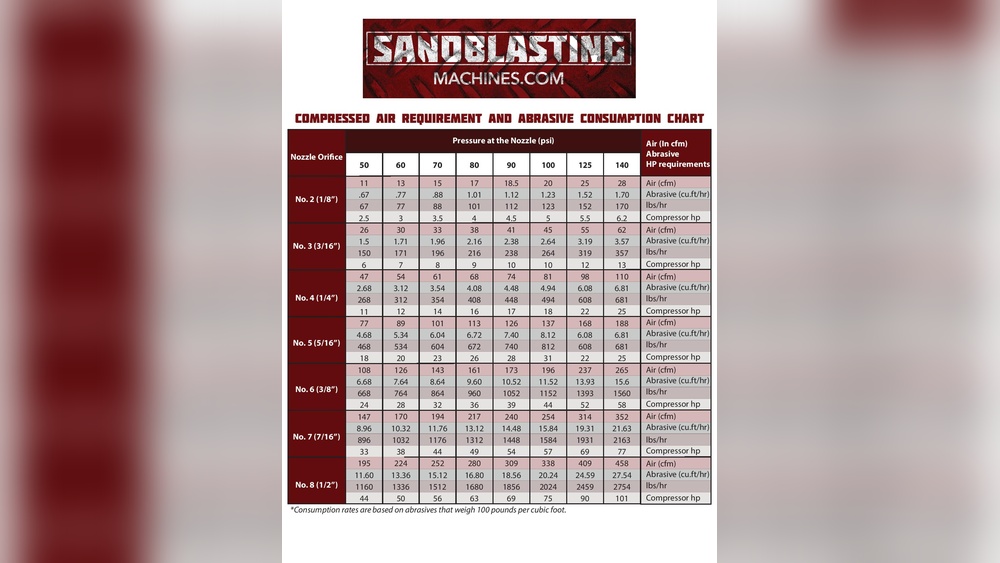
Nozzle Size And Air Consumption
Nozzle size is the single biggest factor. The larger the nozzle, the more CFM you need. Here’s a quick look at how nozzle size impacts air requirement (measured at 90 PSI):
| Nozzle Size (Inches) | CFM Needed (90 PSI) |
|---|---|
| 1/8” | 20 CFM |
| 3/16” | 33 CFM |
| 1/4” | 70 CFM |
| 5/16” | 120 CFM |
Most hobby sandblasters use 1/8” or 3/16” nozzles. Professional, large-scale blasters use 1/4” or larger.
Type Of Abrasive
Denser or heavier abrasives like steel grit require more air to push through the nozzle compared to lighter media like glass beads or walnut shells. If you plan to use heavier abrasive, add 10-20% to your CFM requirement.
Size Of Sandblaster
Cabinet sandblasters (for small parts) need less air, typically 5-20 CFM.
Pressure pot sandblasters (for bigger projects) need much more, often 20-80 CFM or more, depending on the nozzle.
Project Type And Duty Cycle
- Short bursts (cleaning small parts): You can use a smaller compressor or work in intervals.
- Continuous blasting (removing paint from a car): You need a larger compressor with a bigger tank and higher CFM.
If you blast for hours at a time, size up your compressor by at least 25% above the minimum needed.
How To Calculate The Right Air Compressor Size
To find the right air compressor size, follow these steps:
- Choose your nozzle size
- Check the air consumption needed at your target PSI
- Adjust for abrasive type
- Consider continuous vs. intermittent use
- Pick a compressor that delivers at least 10% more CFM than you need
Here’s a typical calculation:
Suppose you use a 3/16” nozzle (needs 33 CFM at 90 PSI), and you use heavy grit. Add 20% for abrasive (33 x 1.2 = 39.6 CFM). For continuous use, add another 10% (39.6 x 1.1 = 43.56 CFM). So, you need a compressor that can deliver at least 44 CFM at 90 PSI for smooth, uninterrupted blasting.
Matching Air Compressor Types To Sandblasting Jobs
Not all air compressors are suitable for sandblasting. Here’s how different types compare:
| Compressor Type | Best For | Typical CFM Range |
|---|---|---|
| Small portable (oil-free) | Detail, hobby work | 2-6 CFM |
| Single-stage stationary | Light cabinet blasting | 10-20 CFM |
| Two-stage stationary | Medium projects | 20-50 CFM |
| Trailer-mounted (diesel) | Industrial/heavy-duty | 80-250+ CFM |
Most home garages use single-stage or two-stage stationary compressors. For car frames or ship hulls, only a trailer unit will do.
Common Air Compressor Sizes For Popular Sandblasting Jobs
Let’s see what size compressor fits some common sandblasting tasks:
- Small hobby parts (cabinet blaster, 1/8” nozzle): 5-10 CFM at 70-90 PSI.
- Bicycle frame or small machinery: 10-20 CFM at 90 PSI.
- Car wheels or panels: 20-30 CFM at 90-100 PSI.
- Complete car body (large nozzle, heavy abrasive): 50-70 CFM at 100 PSI.
- Boat hulls, industrial work: 100+ CFM at 100-125 PSI.
If you want flexibility for different projects, consider a slightly larger compressor than your minimum need.
Compressor Tank Size And Why It Matters
Many buyers overlook tank size. The tank does not increase CFM, but a larger tank can provide a buffer for short-term high-demand. For example, a 60-gallon tank lets you blast for a few minutes before pressure drops, even if your compressor’s CFM is a bit low. For continuous blasting, tank size matters less than CFM, but for short or intermittent jobs, a bigger tank can help compensate for a lower CFM compressor.

Credit: www.bigrentz.com
Common Mistakes When Choosing Compressor Size
Underestimating Air Demand
Many people choose a compressor based on the “maximum” CFM, not the delivered CFM at pressure (e.g., 90 PSI). Always check the delivered CFM at your working PSI.
Ignoring Duty Cycle
A compressor not rated for continuous duty may overheat or wear out quickly during long blasting sessions. Make sure your compressor can run as long as you need without risk.
Not Considering Hose Size And Length
Using a long or narrow hose can drop your air pressure and CFM before it reaches the blaster. For sandblasting, use a short, wide-diameter hose to minimize losses.
Overlooking Moisture And Filtration
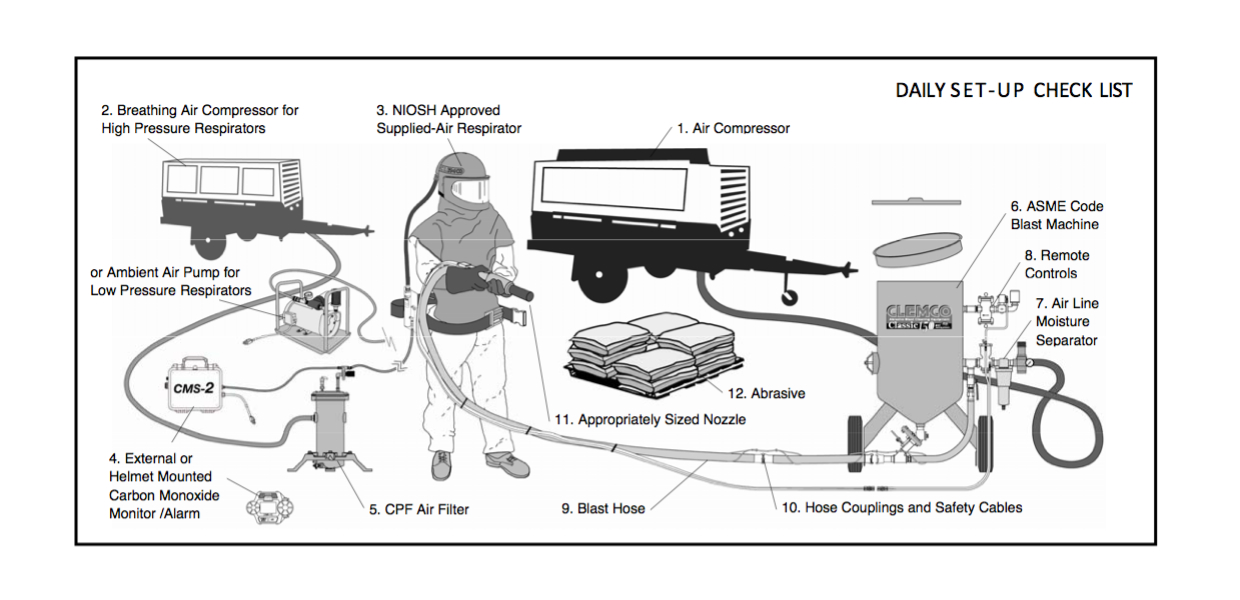
Sandblasting requires clean, dry air. Moisture can cause clogs or rust in your equipment. Consider adding a moisture separator or air dryer to your system.
How To Upgrade Your Air Compressor System For Sandblasting
If your current compressor is a bit small, there are some tricks to get better results:
- Work in short intervals: Blast for 1-2 minutes, then let the compressor catch up.
- Use a smaller nozzle: Reduces air demand, but slows your work.
- Upgrade to a two-stage compressor: Delivers more air at higher pressures.
- Add a second compressor in parallel: Not common, but it can double your available CFM if done correctly.
But remember, nothing replaces having the right size compressor for the job.
Credit: nigen.com
Real-world Examples
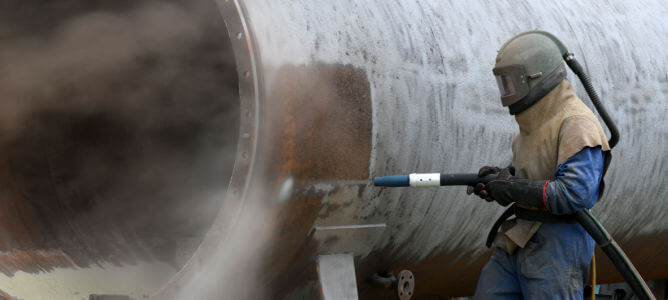
Suppose you want to restore an old car with heavy rust. You use a 1/4” nozzle and coarse grit. You’ll need about 70-80 CFM at 90-100 PSI for continuous blasting. Most home compressors can’t deliver this, so you’d need to rent a diesel trailer compressor.
For restoring small motorcycle parts in a cabinet with a 1/8” nozzle, a 10 CFM, 60-gallon single-stage compressor is enough.
How To Read Compressor Specs Like A Pro
Compressor ads often show two CFM numbers: “displacement CFM” (theoretical maximum) and “delivered CFM” (actual output at a given PSI). Always use delivered CFM at 90 PSI for sandblasting calculations. If the spec doesn’t say, ask the seller for this number.
Cost Vs. Performance: Is Bigger Always Better?
Bigger compressors cost more, use more power, and take up more space. For hobby use, a 10-20 CFM compressor covers most needs. For professional work, invest in the biggest compressor your budget allows. Renting for big jobs is often cheaper than buying.
Maintenance Tips For Long Life
Sandblasting is hard on air compressors. Check these tips:
- Drain your tank daily: Prevents water buildup.
- Clean intake filters: Keeps air flow strong.
- Check hoses and fittings: Look for leaks or wear.
- Change oil (if oil-lubricated): Follow the manufacturer’s schedule.
- Monitor temperature: Overheating shortens compressor life.
A well-maintained compressor lasts longer and performs better.
Credit: petroleumservicecompany.com
Advanced: Multi-user Or Industrial Sandblasting
If you run multiple blasters at once, add up the total CFM needed and choose a compressor with at least 10% extra capacity. For example, two operators with 1/4” nozzles will need about 150 CFM total. Industrial compressors are a must in this case.
Quick Reference: Air Compressor Sizing For Sandblasting
Here’s a handy cheat sheet:
| Sandblasting Job | Nozzle Size | CFM Needed | Compressor Type |
|---|---|---|---|
| Cabinet (small parts) | 1/8” | 5-10 | Single-stage |
| Bicycle Frame | 3/16” | 15-25 | Single or Two-stage |
| Car Panel | 1/4” | 30-50 | Two-stage |
| Industrial | 5/16”+ | 100+ | Diesel Trailer |
Final Thoughts
Choosing the right air compressor for sandblasting is all about matching your equipment, project size, and abrasive to a compressor that provides enough CFM at the required PSI. Start by finding the CFM requirements for your nozzle and abrasive, then add a margin for continuous use and system losses. Remember, a compressor that’s too small will lead to frustration and poor results, while an oversized unit can be expensive to buy and run.
If you’re unsure, consult with a sandblasting supplier or rent a larger unit before buying. With the right setup, you’ll get fast, clean results and protect your tools for years to come.
For more technical details on sandblasting and air compressors, you can explore the Wikipedia page on sandblasting.
Frequently Asked Questions
What Is The Minimum Air Compressor Size For Sandblasting?
For small cabinet sandblasters, you need at least 5-10 CFM at 70-90 PSI. For larger outdoor blasters, start at 20 CFM and go up depending on your nozzle size and abrasive.
Can I Use A Small Pancake Compressor For Sandblasting?
No, pancake compressors (2-6 CFM) are too small for most sandblasting tasks. They can’t deliver enough air for even short jobs.
Does Tank Size Matter For Sandblasting?
Tank size helps for short or intermittent blasting but doesn’t replace CFM. For continuous work, focus on delivered CFM at your working pressure.
How Do I Reduce Moisture In My Air Supply?
Use an air dryer or moisture separator between the compressor and sandblaster. Drain your tank daily, especially in humid climates.
Can I Run Two Sandblasters From One Compressor?
Yes, but you need to add the CFM requirements for both units and choose a compressor with 10-20% extra capacity. For most home compressors, this isn’t possible—you’ll need a large industrial or trailer-mounted unit.