When you want to use a nail gun for your project, choosing the right air compressor size is a key step that many people overlook. The wrong compressor can make your work slow, frustrating, or even damage your tools. But with a bit of understanding, you can match your nail gun to the perfect compressor and get the job done smoothly every time.
Air compressors come in many sizes, and nail guns have different air needs. From small brad nailers for delicate trim to heavy framing nailers for building structures, the right pairing will save you headaches and money. Let’s explore exactly what size air compressor you need for your nail gun, why it matters, and how to make the best choice for your tasks.
Understanding Air Compressor Basics
Before diving into compressor sizes, it helps to know a few key terms:
- CFM (Cubic Feet per Minute): This shows how much air the compressor can deliver. Nail guns need a steady air flow, so matching CFM is important.
- PSI (Pounds per Square Inch): This is the air pressure. Each nail gun has a minimum and maximum PSI requirement.
- Tank size: Measured in gallons, this tells you how much air the compressor can store. A larger tank lets you use the gun longer before the compressor refills.
Most air compressors for nail guns range from 1 to 8 gallons in tank size, with CFM between 0. 5 and 5. 0 at 90 PSI.
Types Of Nail Guns And Their Air Requirements
Different nail guns need different amounts of air. Here are the main types and their typical requirements:
Brad Nailer
Brad nailers are used for thin trim, picture frames, and small wood projects. They use 18-gauge nails and require less power.
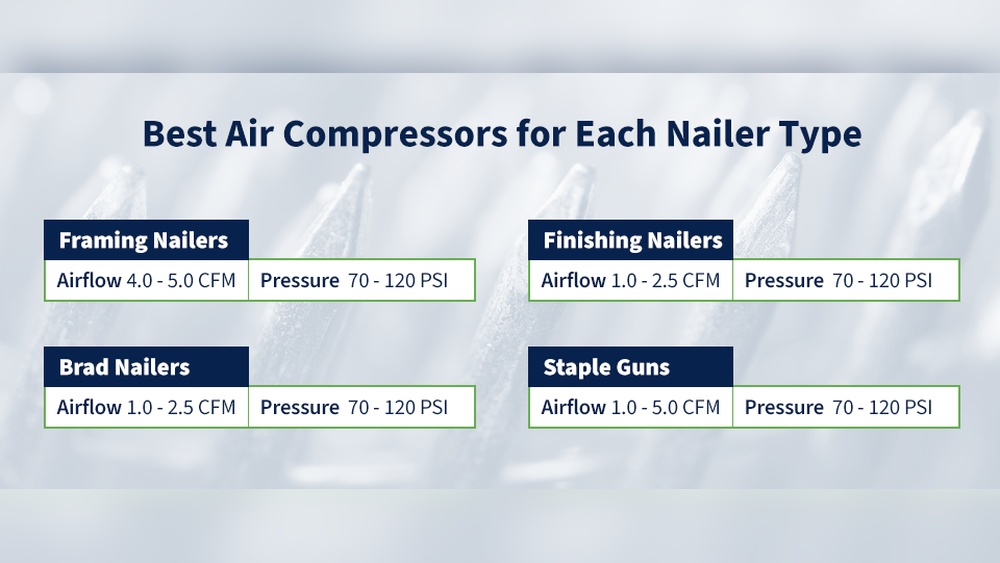
- CFM needed: 0.3 to 0.5 CFM at 70-90 PSI
- Tank size: 1 to 2 gallons is enough
Finish Nailer
Finish nailers handle larger trim, baseboards, and cabinetry work. They use 15 or 16-gauge nails.
- CFM needed: 0.5 to 1.0 CFM at 70-100 PSI
- Tank size: 2 to 4 gallons recommended
Framing Nailer
Framing nailers are for heavy construction like framing walls or decks. These are the most demanding nail guns.
- CFM needed: 2.0 to 4.0 CFM at 90-120 PSI
- Tank size: At least 4 to 6 gallons
Roofing Nailer
Roofing nailers are designed for fast, repetitive work.
- CFM needed: 2.2 to 2.5 CFM at 90-100 PSI
- Tank size: 4 to 6 gallons
Staple Guns And Pin Nailers
These need very little air.
- CFM needed: 0.3 to 0.5 CFM at 60-90 PSI
- Tank size: 1 to 2 gallons
The Relationship Between Cfm, Psi, And Tank Size
Many beginners focus only on tank size, but the most important factor is CFM. If your compressor cannot supply enough CFM, the nail gun will stall or work poorly. PSI must also meet your tool’s needs, but most compressors for home use can reach 90-120 PSI.
Tank size affects how long you can run your nail gun before the compressor turns on to refill. For short bursts, a small tank is fine. For long, repetitive nailing (like framing or roofing), a larger tank means less waiting.
Here’s a helpful comparison of common nail guns and what they need:
| Nail Gun Type | CFM Required | PSI Range | Recommended Tank Size |
|---|---|---|---|
| Brad Nailer | 0.3 – 0.5 | 70 – 90 | 1 – 2 gal |
| Finish Nailer | 0.5 – 1.0 | 70 – 100 | 2 – 4 gal |
| Framing Nailer | 2.0 – 4.0 | 90 – 120 | 4 – 6 gal |
| Roofing Nailer | 2.2 – 2.5 | 90 – 100 | 4 – 6 gal |
| Pin/Staple Gun | 0.3 – 0.5 | 60 – 90 | 1 – 2 gal |
How To Match A Compressor To Your Nail Gun
Follow these steps to make sure you pick the right compressor:
- Check your nail gun’s manual for CFM and PSI needs.
- Choose a compressor that delivers at least 20% more CFM than your gun requires. This helps when you work quickly or use longer hoses.
- Pick a tank size based on your project. For short, light tasks, a small tank is fine. For big jobs or multiple users, go bigger.
- Consider portability. If you move around a lot, smaller compressors are lighter and easier to carry.
- Think about future tools. If you may buy more air tools later, get a slightly larger compressor now to save money later.
Here’s an example: If your framing nailer needs 2.5 CFM at 90 PSI, look for a compressor that can deliver at least 3.0 CFM at 90 PSI, with a 4-6 gallon tank.

Credit: veterinavitkovice.cz
Common Mistakes When Choosing An Air Compressor
Many people make these mistakes when buying a compressor for their nail gun:
- Buying only by tank size: Tank size alone doesn’t guarantee enough air flow. Always check CFM.
- Ignoring duty cycle: Some compressors can’t run non-stop. For big projects, a higher duty cycle (like 50% or more) is better.
- Overestimating needs: A huge compressor is heavy, noisy, and expensive. Don’t buy more than you need.
- Using long, thin hoses: Long hoses reduce air pressure and flow. Use thick, short hoses when possible.
A non-obvious tip: Ambient temperature can affect compressor performance. In cold weather, oil-lubricated compressors can struggle to start. For outdoor winter jobs, look for oil-free models or keep the compressor warm.
Portable Vs. Stationary Compressors
For most nail gun users, portable compressors (1-6 gallons) are best. They are light, easy to move, and provide enough air for most trim and finish work.
Stationary compressors (20+ gallons) are for workshops and large projects with multiple tools running at once. If you’re a professional framer or roofer, or you want a compressor for other demanding air tools (like sanders or grinders), a stationary model may be worth the investment.
Here’s a quick comparison:
| Compressor Type | Tank Size | Portability | Best Use |
|---|---|---|---|
| Portable | 1 – 6 gal | Easy to carry | Trim, finish, small jobs |
| Stationary | 20+ gal | Fixed position | Large projects, workshops |
Single Vs. Multiple Nail Guns
If you plan to use more than one nail gun at the same time, add the CFM requirements together. For example, if you use two finish nailers (each 0.7 CFM), your compressor should provide at least 1.7 CFM (add 20% for safety).
This is something many beginners miss. Using multiple tools at once can quickly overload a small compressor, leading to delays and uneven nailing.
Oil-free Vs. Oil-lubricated Compressors
Oil-free compressors are common for home users. They require less maintenance, are lighter, and start easily in any weather. Oil-lubricated compressors are quieter and last longer, but they need regular oil changes and are less portable.
For trim and finish nail guns, an oil-free compressor is usually best. For heavy framing or workshop use, an oil-lubricated model is worth considering.
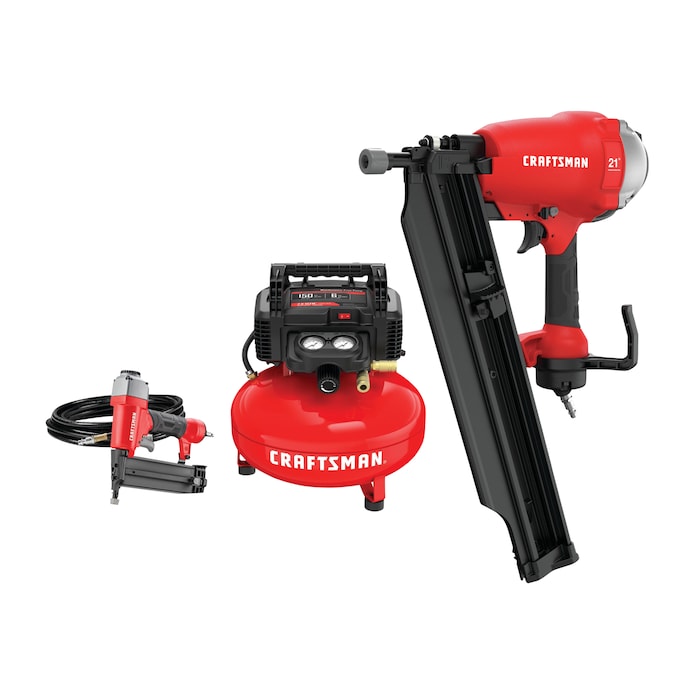
Credit: www.lowes.com
Real-world Examples
Let’s look at a few situations:
- DIY baseboard installation: A 2-gallon, oil-free compressor with 1 CFM at 90 PSI is perfect for a finish nailer.
- Building a deck: For a framing nailer, you’ll want a 6-gallon, oil-lubricated compressor with at least 3 CFM at 90 PSI.
- Roofing: A 6-gallon pancake compressor with 2.5 CFM at 90 PSI can power most roofing nailers for shingle work.
It’s better to slightly oversize your compressor than to undersize it. Running out of air halfway through a project is frustrating.
Maintenance And Longevity Tips
- Drain the tank after each use to prevent rust.
- Check the air filter regularly.
- Use the right oil for lubricated models.
- Store indoors in winter to avoid freezing.
A well-maintained compressor will last many years and work more efficiently.

Credit: www.youtube.com
Environmental And Safety Considerations
Always use compressors in a well-ventilated area. Noise can be a problem—look for models rated under 70 decibels for quieter operation. Never exceed your nail gun’s recommended PSI. Over-pressurizing can damage the tool or cause accidents.
If you’re working indoors, consider models with thermal overload protection. This stops the compressor if it overheats, reducing fire risk.
Choosing The Right Brand And Features
Trusted brands like DeWalt, Makita, and Porter-Cable are popular for a reason: they’re reliable and easy to service. Features like quick-connect couplers, rubber feet, and easy-access drain valves make a real difference in daily use.
Some compressors now come with roll cages to protect the motor and tank. This is very useful on busy job sites.
For more details on compressor safety and standards, check out the official OSHA guidelines.
Frequently Asked Questions
What Happens If My Air Compressor Is Too Small For My Nail Gun?
If your compressor cannot deliver enough CFM, your nail gun may misfire, shoot nails unevenly, or stop working after a few shots. You’ll also spend a lot of time waiting for the compressor to catch up.
Can I Use A Pancake Air Compressor For Framing?
You can use a 6-gallon pancake compressor for small framing jobs, but it may not keep up with fast nailing. For larger jobs, choose a bigger tank and higher CFM.
Is Higher Psi Always Better For Nail Guns?
Not always. Most nail guns work best at their recommended PSI. Too much pressure can damage seals or send nails too deep, which can ruin your workpiece.
Can I Use The Same Air Compressor For Different Nail Guns?
Yes, as long as your compressor can deliver the highest CFM and PSI needed by your tools. Always check the requirements for each nail gun.
How Important Is The Hose Size For My Nail Gun Setup?
Hose diameter and length affect air flow. A longer or thinner hose can cause pressure drop, making your nail gun less powerful. Use the shortest, thickest hose you can for best results.
Choosing the right air compressor size for your nail gun is an investment in your work’s quality and your own peace of mind. Take the time to match your tools and projects, and you’ll get better results with less stress. With the tips and examples above, you’re ready to make a smart, confident choice for any nailing job.