
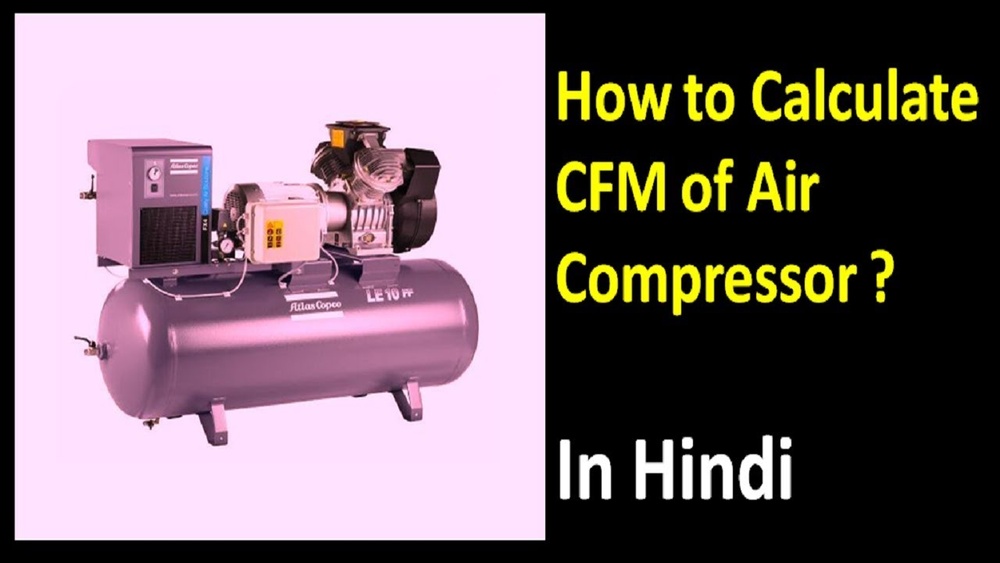
Figuring out the CFM of an air compressor is essential for anyone who wants to use pneumatic tools or run air-powered equipment efficiently. Whether you’re a DIY enthusiast, workshop owner, or someone working in manufacturing, knowing the correct CFM (cubic feet per minute) helps you choose the right compressor and avoid costly mistakes. But for many people, CFM calculations and compressor specs can be confusing, especially if English isn’t your first language. This guide will break down everything you need to know about calculating CFM, using simple words and clear examples. You’ll also learn why CFM matters, how it affects your tools, and how to avoid common mistakes that even experienced users sometimes make.
What Is Cfm And Why Does It Matter?
CFM stands for cubic feet per minute. It tells you how much air a compressor can deliver in one minute. Think of CFM as the “power” of air flow. If your tools need more air than your compressor can supply, they won’t work properly.
For example, a paint sprayer might need 7 CFM, while a small nail gun may only need 2 CFM. If your compressor only provides 5 CFM, that paint sprayer will not spray smoothly. So, always match the CFM rating of your compressor to the needs of your tools.
Psi Vs Cfm: What’s The Difference?
Another number you’ll see is PSI (pounds per square inch). PSI is the pressure of the air, while CFM is the amount of air. Both are important. Most tools list both numbers, such as “5 CFM at 90 PSI.” Always check both ratings, but CFM is usually the more limiting factor for tool performance.
How To Calculate The Cfm Of Your Air Compressor
Knowing how to figure out the CFM of your air compressor helps you:
- Understand what tools you can run
- Prevent overloading your compressor
- Make better buying decisions
Step 1: Gather Basic Information
Before you start, you need:
- The tank size of your compressor (in gallons or liters)
- The starting and ending pressure (PSI)
- The time it takes to fill the tank between these pressures (seconds)
You’ll also need the standard atmospheric pressure, which is about 14.7 PSI at sea level.
Step 2: Convert Tank Size To Cubic Feet
Most compressors list tank size in gallons. To calculate CFM, convert gallons to cubic feet:
- 1 gallon = 0.1337 cubic feet
So, if your tank is 20 gallons:
20 Gallons × 0.1337 = 2.674 Cubic Feet
Step 3: Find The Pressure Change
Subtract the starting PSI from the ending PSI. For example, if you start at 90 PSI and end at 120 PSI:
120 Psi – 90 Psi = 30 Psi
Step 4: Time The Compressor Filling
Use a stopwatch to measure how many seconds it takes for the compressor to go from the lower pressure to the higher pressure. Let’s say it takes 60 seconds.
Step 5: Calculate Actual Cfm Output
Now, use this formula:
CFM = (Tank Volume in Cubic Feet × Pressure Change in PSI × 14. 7) / (Atmospheric Pressure × Time in Seconds) × 60
Let’s use our example:
- Tank Volume = 2.674 cubic feet
- Pressure Change = 30 PSI
- Time = 60 seconds
- Atmospheric Pressure = 14.7 PSI
CFM = (2. 674 × 30 × 14. 7) / (14. 7 × 60) × 60
First, (2.674 × 30) = 80.22
Then, (80.22 × 14.7) = 1,179.23
Divide By (14.7 × 60) = 882
Now, 1,179.23 / 882 = 1.338
Multiply By 60 = 80.28 Cfm
Wait, that seems very high for a small compressor. The error is in the formula’s final multiplication. The actual formula is:
CFM = (Tank Volume × Pressure Change) / (14. 7 × Time in seconds) × 60
Let’s try:
CFM = (2. 674 × 30) / (14. 7 × 60) × 60
(2.674 × 30) = 80.22
(14.7 × 60) = 882
- 22 / 882 = 0.091
- 091 × 60 = 5.46 CFM
This is a more realistic number for a 20-gallon compressor.
Step 6: Adjust For Real-world Conditions
Manufacturers sometimes list “displacement CFM” (theoretical) and “delivered CFM” (actual output). Delivered CFM is always lower because of heat loss, leaks, and mechanical inefficiency.
- Displacement CFM: Calculated from the compressor’s pump size and speed.
- Delivered CFM: Measured at the outlet, under real working conditions.
Always trust the delivered CFM number if you can find it.
How Cfm Affects Tool Performance
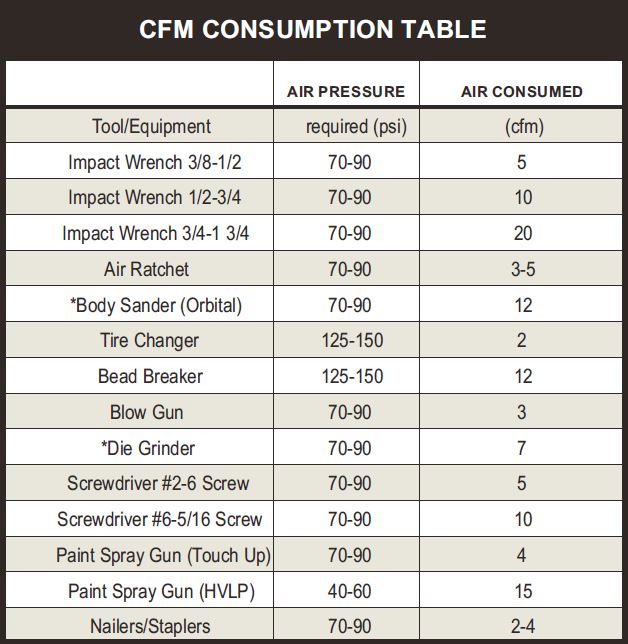
Every air tool has a CFM requirement. If your compressor’s CFM is too low, you’ll notice:
- Tools lose power
- Performance is inconsistent
- The compressor runs too often and overheats
If you use several tools at once, add their CFM needs together. For example, running a grinder (5 CFM) and a spray gun (4 CFM) at the same time means you need at least 9 CFM.
Here’s a quick comparison of common tool CFM requirements:
| Tool Type | Average CFM Needed | Typical PSI |
|---|---|---|
| Brad Nailer | 0.5 – 1 | 60 – 90 |
| Impact Wrench (1/2″) | 4 – 5 | 90 – 100 |
| Paint Sprayer | 6 – 7 | 40 – 60 |
| Die Grinder | 4 – 6 | 70 – 90 |
| Sandblaster | 10 – 15 | 90 – 100 |
Factors That Affect Cfm Calculations
Several things can change your actual CFM:
Altitude
At higher altitudes, the air is thinner, so compressors produce less CFM. If you live far above sea level, your real CFM will be lower than what the label says.
Temperature And Humidity
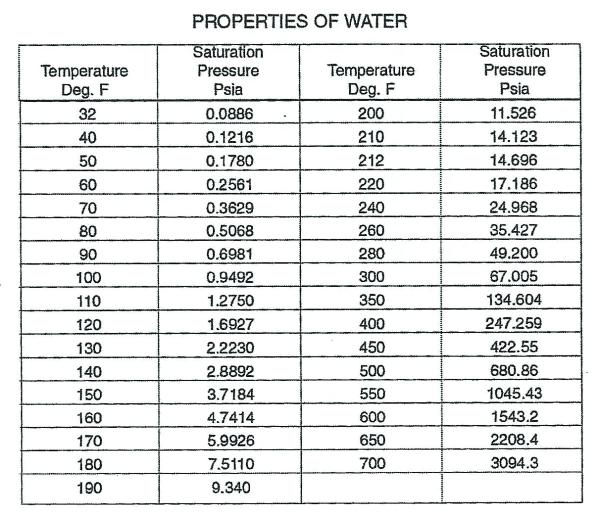
Warmer air is less dense, so compressors produce less CFM in hot weather. High humidity also reduces efficiency.
Duty Cycle
The duty cycle is how long your compressor can run before resting. Most small compressors have a 50% duty cycle. That means they should only run half the time. If you run a compressor at 100% duty cycle, it will overheat and wear out quickly.
Hose Size And Length
Long or narrow hoses cause pressure drops, reducing the effective CFM at your tool. Always use the shortest, widest hose practical for your setup.
| Hose Length (feet) | Hose ID (inches) | Pressure Drop (PSI) |
|---|---|---|
| 25 | 3/8″ | 1 |
| 50 | 1/4″ | 5 |
| 100 | 3/8″ | 4 |
Credit: www.airbestpractices.com
How To Choose The Right Compressor For Your Needs
When shopping for an air compressor, CFM is usually the most important number. But you should also consider:
1. Your Tool’s Cfm And Psi Needs
Check the manual or product label for each tool you plan to use. Add up the CFM for all tools you want to run at the same time. Always round up.
2. Allow A Safety Margin
It’s smart to add 25% to your total CFM needs. This extra cushion protects you from unexpected drops in performance and future tool upgrades.
3. Compressor Duty Cycle
If your compressor has a 50% duty cycle, it can only supply its rated CFM half the time. If you need continuous air, choose a compressor with a 100% duty cycle or buy a larger unit.
4. Portability And Space
Bigger compressors are heavier and less portable. If you need to move your compressor often, balance CFM with size and weight.
5. Power Source
Check if your workspace supports the voltage and amperage needed for the compressor. Many high-CFM compressors require a 220V circuit.
Real-world Example: Calculating Cfm For A Workshop
Imagine you want to run an impact wrench and a spray gun at the same time.
- Impact wrench needs 5 CFM at 90 PSI
- Spray gun needs 7 CFM at 40 PSI
Total Cfm Needed = 5 + 7 = 12 Cfm
Add A 25% Margin: 12 × 1.25 = 15 Cfm
Look for a compressor rated at least 15 CFM at 90 PSI. If you plan to use both tools for long periods, check the duty cycle to make sure the compressor can keep up.
Two Non-obvious Insights Most Beginners Miss
- CFM ratings are not always at the same PSI. Some manufacturers advertise high CFM at a low PSI to make their compressor look better. Always check the CFM at the pressure your tools need.
- Short bursts vs. continuous use: If you only use a tool in short bursts, you might get by with a smaller compressor. But for continuous use (like grinding or spraying), you need a compressor that matches or exceeds your tool’s CFM at the right PSI.
Common Mistakes When Figuring Cfm
- Ignoring the duty cycle: Running a compressor beyond its limit can shorten its life.
- Not accounting for tool startup surges: Some tools use more air when starting than during steady use.
- Forgetting about future needs: Buying a compressor just big enough for today can limit you later.
- Using long, thin hoses: This reduces effective CFM at the tool.
- Not checking delivered CFM: Only using theoretical numbers can lead to disappointment.
Credit: www.compressorpros.com
Practical Tips For Accurate Cfm Measurement
- Use a real stopwatch when timing your compressor. Guessing the time leads to big errors.
- Test with your actual tools: Run your tools as you normally would and see if the compressor keeps up.
- Check for leaks: Even small leaks in hoses or fittings can reduce available CFM.
- Maintain your compressor: Clean filters and regular oil changes help maintain peak CFM output.
When To Upgrade Your Air Compressor
If you notice your tools slowing down, your compressor running too often, or you want to add more air-powered equipment, it might be time to upgrade. Look for models with higher delivered CFM, a better duty cycle, and a motor that matches your power supply.
For more on air compressor standards and ratings, you can visit this Wikipedia page on air compressors.

Credit: best-aire.com
Frequently Asked Questions
What Does Cfm Mean For An Air Compressor?
CFM stands for cubic feet per minute. It measures the amount of air a compressor can deliver in one minute. The higher the CFM, the more air you get for running tools.
How Do I Find Out The Cfm Of My Air Compressor If It’s Not Labeled?
You can calculate it by measuring your tank size, pressure change, and the time it takes to refill. Use the formula from earlier in this article for an accurate measurement.
Can I Use A Compressor With Lower Cfm Than My Tool Needs?
You can, but the tool may not work properly. It might run slower, lose power, or stop working during use. For short bursts, it’s sometimes possible, but not for continuous work.
Why Is Delivered Cfm Lower Than Theoretical Cfm?
Delivered CFM is measured at the tool’s working pressure, after accounting for losses from heat, leaks, and mechanical inefficiency. Theoretical CFM ignores these factors and is always higher.
Does Altitude Really Affect Cfm?
Yes, at higher altitudes, the air is thinner, so compressors produce less CFM. If you live in the mountains, expect your compressor to deliver less air than the rating at sea level.
Understanding how to figure CFM of air compressor helps you make better choices, avoid costly mistakes, and keep your workshop running smoothly. With this knowledge, you can confidently select, use, and maintain your air compressor for years to come.